

Those are my tomatoes!
Sebastian inherited a tomato farm from his father. It’s a very productive farm of 2,000 acres. In his first year, Sebastian had a bumper crop and made over a million dollars.
Does Sebastian deserve all those tomatoes?
In A Theory of Justice, Rawls argued that justice requires fairness and fairness consists of liberty and equality.
The liberty principle says that everyone should have the same fundamental freedoms. Everyone should be free and have an equal right to vote, equal access to public office and to be treated according to the rule of law.
The equality principle has two parts:
1. Everyone should have equal access to opportunity.
2. Inequality is only allowed if it helps the least well-off (this one is complicated and I will come back to it).
Rawls would say that Sebastian did not deserve to inherit his tomato farm just because he was lucky enough to have rich parents. Following the equality principle, everyone should have equal access to opportunity and most people will not inherit a tomato farm.
According to Rawls, no one deserves any reward that results from luck.
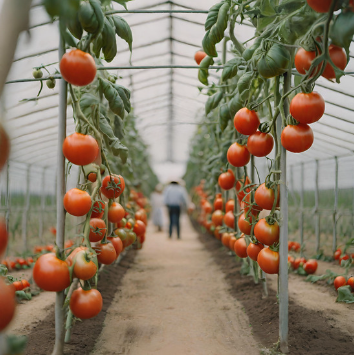
Let’s consider another scenario.
More talent = more tomatoes
Theresa has a natural talent for growing tomatoes. Theresa grew up in a poor family but a teacher gave her a tomato plant when she was young. Theresa nutured that plant and discovered that she was good at growing tomatoes. Every year, she sells her tomatoes and uses the profits to buy more plants and more land to grow her tomato plants. By the time she was twenty-three, Theresa had acquired 2,000 acres and was making over a milllion dollars a year.
Does Theresa deserve all those tomatoes?
According to Rawls, none of us deserves rewards that result from ‘accidents of natural endowment and the contingencies of social circumstance’. Theresa was lucky to have a natural talent for growing tomatoes. Her talent is an accident of natural endowment. So, according to Rawls, Theresa does not deserve her tomato farm and she does not deserve the rewards that accrue from it.
A quick aside about the distinction between deserving a reward and being entitled to a reward. The Stanford Encyclopedia of Philosophy makes the following distinction (my phrasing and examples),
- An entitlement is created by a social institution such as the rules of a lottery. If the rules say that the winner will be awarded £100, then the winner is entitled to the prize money.
- By contrast, desert comes from a moral sense that someone deserves a reward. A team that cheats to win a World Cup quarter-final might be entitled to go through to the semi-final but they did not deserve it (I’m not still bitter, honest).
Rawls would say that Theresa does not deserve her tomato plants either because her natural talent for growing tomatoes is an accident of luck but I think Rawls is wrong on this point. I believe that someone who has a natural talent for growing tomatoes deserves the tomatoes that she grows and the profits she makes from selling them.
Here’s another case.
Hard work = more tomatoes
Miguel has no talent for growing tomatoes and he did not inherit a tomato farm from his parents. However, Miguel works hard. Theresa hires Miguel to work on her tomato farm and pays Miguel a portion of the profits. Miguel works hard and makes a lot of money from his hard work.
According to Rawls, Miguel’s predisposition to work hard also results from luck. Perhaps Miguel was born with Hard-Work genes or perhaps Miguel’s parents instilled in him the propensity to work hard. Either way, according to Rawls, Miguel was just lucky to develop a character trait that lazy people do not enjoy and Miguel does not deserve the rewards that accrue from his hard work.
It seems to me that Rawls’s account does violence to the meaning of the word deserve. If we can’t reward talent, hard work, diligence, kindness or determination (all accidents of natural endowment or social circumstance) then the word means nothing useful at all.
I propose that contra Rawls, we absolutely should reward talent, hard work, diligence, kindness and determination. The people who have these attributes and put them to productive use should be rewarded more highly than people who do not. I believe it’s a moral issue. Morally, I think that Theresa and Miguel deserve their tomatoes. They worked hard for their tomatoes and the tomatoes belong to them legally (entitlement) and morally (desert).
Rawls said that, although they do not deserve special rewards, talented and hard-working citizens would be entitled to additional rewards if and only if they resulted in benefits to the least well-off in society and I will consider this in a separate post.
Jeez, doesn’t ANYBODY deserve tomatoes?!
Theresa does. She worked has a natural talent for growing them. Miguel does too. He worked hard for them.
If we’re talking about rewarding people for their actions in order to influence behavior – it depends what you’re solving for. I would reward effort more than natural ability if I were to say raise a child, I might reward natural ability more if hiring an athlete for my team – dunno.
I feel better about myself when I work particularly hard than I do if I achieve some notable outcome for reasons other than effort.
Rawls was solving for Justice which he equated with fairness. It’s not fair to be rewarded or punished for something that happened by luck.
To develop and prosper, society relies on incentivising effort. Experiments to remove it (think post- war Russia) eventually implode.
Rawls said that we can incentivize effort and profits are allowed, but only if they benefit the least well-off. Rawls was not a communist.
Indeed, but for society to benefit from ever more and better tomatoes, the incentive needs to motivate the producer. How did Rawls (or communist Russian during the collective agriculture period) propose the worse off were to become wealthier, if not by this mechanism?
My copy of A Theory of Justice has just shipped. I’ll let you know in a few weeks!
FWIW I agree with you, David. I am a meritocrat and disagree quite strongly with Rawls’ egalitarianism.
Once again I’m in agreement. Have you read The Tyranny of Merit by Sandel? I went to the lecture, I have it, it’s on my to-read list, it even has the merit(!) of being quite short, but it’s not been opened yet.
I read his Justice. It was very good but I disagreed with most of it. I will read The Tyranny of Merit at some point but my book pile is rather large at the moment including…. A Theory of Justice by John Rawls!
I read The Aristocracy of Talent: How Meritocracy Made the Modern World over the summer. It is very good. It’s more history than philosophy. I meant to write a review of it but forgot! I should do that.
The biggest takeaway for me is that everyone in politics was pro-meritocracy until the 1950s until someone realised that if smart people had an opportunity to get rich, there wouldn’t be any smart poor people left.
Where then, does Rawls suggest the fruits of Sebastian’s, Theresa’s and Miguel’s labour go?
In the case of Sebastian’s parents, if they worked hard for their tomato business like Miguel, and/or had tomato skills, like Theresa, do they not “deserve” to leave it to their son and, similarly, why shouldn’t he be a beneficiary and why shouldn’t he enjoy the USD1mm he makes from the business (as he clearly has a talent for continuing the tomato business – assuming they do not grow themselves)? Yes, Sebastian had a start absent to others, but his endeavour or talent must be applied for the business to continue.
Seemingly, for Rawls, no one deserves tomatoes.
I’ll write more about this in episode two. Basically, the tomato growers are entitled to profit from tomato growing (though they do not deserve the profits) as long as it benefits the least well-off.
Hi Kevin
I’ve always wondered if we interpret Rawls too literally. His point regarding desert…isn’t it really just a philosophical point! By which I mean, …upbringing, education and even propensity to work (by inheriting a ‘hard work gene’), all play their role in where people are situated in terms of equality/inequality with each other. His point regarding desert was purely to demonstrate that people ‘have more/or have less’ because of their original position of inequality. So he would probably say that Sebastian didn’t deserve (in a theoretical way) his tomato farm and the resulting profits, any more than anybody did.
That said, Rawls was not indicating that the tomato farm and its profits should be taken away from Sebastian. After all, we all need tomatoes!!! Sebastian could keep his farm and profits on account of the ‘difference principle’ which benefited the least well off on account of 1/ it provided work for many 2/ it produced health giving vitamin c enriched fruit (a fruit!!!) and 3/ the greater profits would result in greater taxation!
A point of debate is the precise application of the difference principle. My introduction to it was in A113 Revolutions, where Barber wrote ‘removing these inequalities would make the least well off even worse off’ which seems to imply to me that Sebastian can keep his tomato farm and profits (even tho he doesn’t technically deserve them any more than anybody else) since taking them away would make ‘the working class even more worse off’ in respect of 1/no jobs 2/no tomatoes and 3/ less tax to fill the potholes! (Rawls did actually say ‘the greater expectations allowed to entrepreneurs encourages them to do things which raise the prospects of labouring class’).
I’m sure the things you find contentious are purely philosophical/political points …and in reality he would agree with you, that talent, diligence etc should be rewarded. At least I hope he would! I certainly agree with you on that!
My final thought … ‘Give Rawls a break’ (to the tune of Lennon’s ‘Give peace a chance) 🥹
My other final thought … another great read Kevin 😊
(Final, final thought ie Afterthought! I know I have based my response on the ‘difference principle’ which you said u will address separately, but for me it is the linchpin of his theory and I can’t separate the two issues when appraising Rawls )
Blood hell! Another afterthought… I’ve just seen your comment from 3rd Nov! It seems my comments here were unnecessary 😫😂
Thanks for the feedback, Angela! I love feedback!
I disagree with you on Rawl’s thoughts on who deserves what. I think it’s a moral issue. Morally, I think that Theresa and Miguel deserve their tomatoes. They worked hard for their tomatoes and the tomatoes belong to them legally (entitlement) and morally (deserve). I think that Rawls would disagree. We’d both agree that Sebastian just got lucky. He is entitled to them legally but morally, he did nothing to deserve them. There’s a moral difference between the three cases.
Come the revolution, I will have Sebastian’s tomato farm confiscated and the proceeds will be used to provide opportunities for people who have no tomatoes.
I disagree about the Difference Principle too. I’ll say more about that in episode two.
Hmmm! So Teresa who you say deserves her million plus pounds per year ( and I don’t disagree) on account of her talent for growing tomatoes is not going to be allowed to pass her tomato farm down to her offspring without risk of some Revolutionary coming along and confiscating it for the benefit of others who have no tomatoes. I’m just not entirely sure about this (will ponder it further), but perhaps you think it’s ok on the account of the morality factor!
The rich tomato farmers who keep their farms in their family for generations make it harder for the Miguels and the Theresas of the world to succeed. Everyone should have an equal opportunity to succeed, not just the children of rich tomato farmers.
Disclaimer!!!!! My comments relate to your original version of this article, they may no longer be relevant!
I took your excellent feedback into account when I wrote version two, Angela.
But no one will know because the new one is over here:
https://raggedclown.substack.com/p/those-are-my-tomatoes