Most of us would probably agree that dying is the worst thing that can happen to us. Being alive is always better than being dead. But wait! While death is pretty bad, it’s not as bad as being tortured. You probably don’t want to watch your children get murdered either. Maybe dying is not the worst thing that can happen.
He who pretends to look on death without fear lies. All men are afraid of dying. This is the great law of sentient beings, without which the entire human species would soon be destroyed.
— Jean-Jacques Rousseau
Dying is not the same as being dead, though. You are still alive while you are dying. Dying can drag on and on, bringing pain while your organs shut down. Once you are dead, your pain will be gone — but your pleasures will be gone, too. You won’t have any awareness of being dead, and you will be dead forever (Belshaw). But before you have to die, you have to live, and that’s where we’ll start.
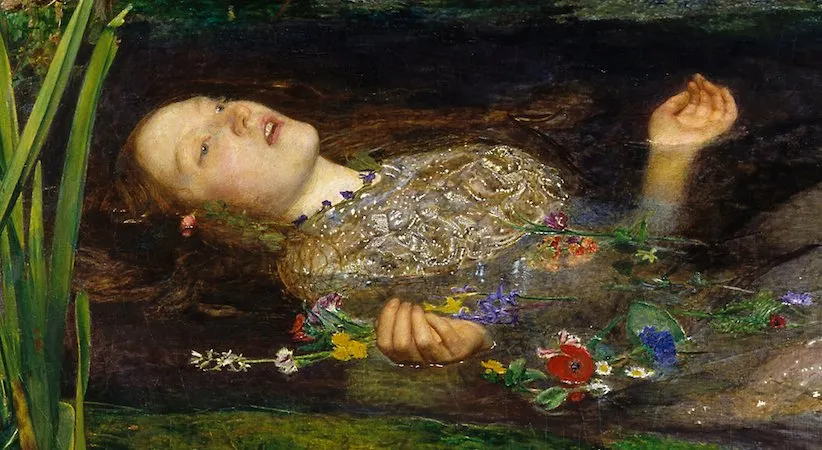
Ophelia (1852) by John Everett Millais
How long do you want to live?
When you arise in the morning, think of what a precious privilege it is to be alive – to breathe, to think, to enjoy, to love.
— Marcus Aurelius
Dying young is the saddest time to die. Someone who has been around a long time will usually be more prepared to die than someone who just turned twenty. But how long will be long enough?
Philosopher Bernard Williams says that most of us would prefer to live forever. Some people would be happy to just sit and look out of the window for an infinity of years, and Williams calls this just living. But while just living is good enough for many, the rest of us need more excitement to make life worthwhile. But how much excitement?
Imagine you are Eric Clapton and you are pretty good at playing the guitar. You know quite a few rock songs and can play them well. If you practice for a few more decades, maybe you can learn to play all the songs. But eventually, you’ll get bored with playing the guitar. Maybe you can learn something else? Try the piano? Drums? They’ll all get boring after infinite days. Painting? Science? Cooking? Visiting Polynesian Islands? The list is finite, and you’ll eventually be bored with all of them. You’ll end up just living, and who wants nothing but just living for the rest of time?
Williams says we pursue some desires, like eating when we are hungry or sleeping when we are tired, just to stay alive. Other desires, like raising a child or achieving a lifelong ambition, give our lives meaning. But when we are done with all those, living forever doesn’t sound so appealing. Satisfying the same desires forever is no longer desirable.
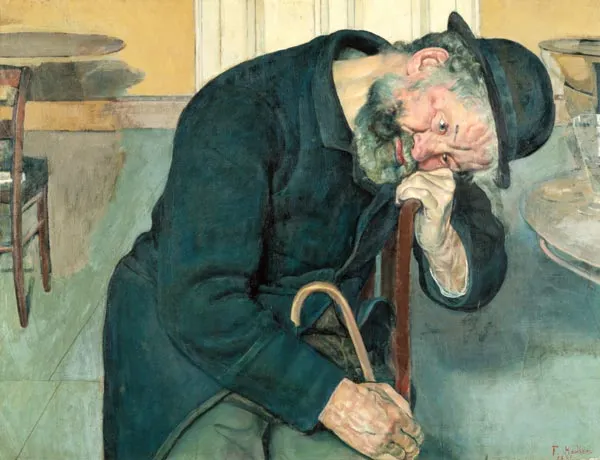
Soul (old man) disappointed (1891 by Ferdinand Hodler
The arguments so far are hypothetical. We don’t really have the option of living forever to satisfy our desires. In the real world, we have our three score years and ten —and maybe just a little bit more — but is that long enough? Learning the guitar and raising those grandchildren fits into an average lifetime. You could even visit Tahiti or live in Manhattan, too. But once you get past eighty, visiting Tahiti seems less appealing, and eventually, just living will be all that fills your days.
The days of our years are threescore years and ten; and if by reason of strength they be fourscore years, yet is their strength labour and sorrow; for it is soon cut off, and we fly away.
— Psalm 90, KJV
Epicurus says we should not fear death because we won’t even be there. Lucretius, too, asks: if we aren’t afraid of the time before we were born, why should we be afraid of the time after we die? What is there to be afraid of?
When death is there, we are not, and when we are there, death is not
— Epicurus
These arguments from Epicurus and Lucretius say we should not be afraid of death, but they say nothing about how much we can enjoy being alive. Even if being dead isn’t so bad, we’ll miss out on the things that make us happy.
The most important thing is to enjoy your life—to be happy—it’s all that matters. — Audrey Hepburn
But being happy doesn’t last forever. As we get older, our ability to enjoy life’s pleasures declines. We get sick and endure pain. Our bones get weak, and our senses fade. Eventually we might decide that dying wouldn’t be so bad (Williams). But how do we balance the good things against the bad things? How should we choose when to die?
Thomas Nagel has a little thought experiment for us. Imagine that every Monday, after your cup of coffee, you are given a choice: you can live one more week, or you can die painlessly in a few minutes. Nagel says he would always choose to live another week. What would you choose? Would you make the same choice forever?
According to Williams, it’s nearly always too early or too late to die. The simplest solution is to do nothing and just accept the day that death arrives. If we are lucky, we’ll die just before it becomes unpleasant to stay alive. Tacitus had something to say about that.
Tu vero felix, Agricola, non vitae tantum claritate, sed etiam opportunitate mortis.
[You were truly lucky, Agricola, not only in the brilliance of your life, but also in the timing of your death.]
— Tacitus
But what if you are not lucky?
We’ve talked about those who die in their 20s — non vero felix! — but what about those who live to eighty or ninety? I expect it’s always too early for some — many will want to watch their grandchildren grow, or walk in the park with an elderly sweetheart — but what about when that is all over?
Just living will be enough for some, but not for me. I have my early death booked already, even if I haven’t picked a date yet. Whether that involves a trip to Switzerland, some opium poppies or an uninvited visitor in my brain, I’d prefer an early departure to just living.
Betty said she prayed today For the sky to blow away Or maybe stay She wasn’t sure
— Nick Drake
People die in many different ways. Which way would you choose, if you could choose? The easiest option is to live until you are 90 and then let nature take you away — but that’s not what I would choose for myself.
Many would rather die suddenly, with no expectation that the end is coming. Maybe you are flying over the Alps, and the captain announces that you are going to crash. You have a little time to say your prayers. You can even call your wife and tell her you love her, but you won’t be coming home. Even better, perhaps the plane explodes before you even know what’s going on. You have no time to regret all the things you haven’t done yet, and no time to be afraid of the death that will take you away. You are just gone. If this one’s your favourite, you could learn rock climbing or white water kayaking.
Too many people have to face a horrible disease that keeps them around for a few days… or months… or years. Or maybe the disease is not so horrible; it’s fatal, but without the excruciating pain. You don’t know exactly when death is coming, but you know it is coming, and you have time to teach your family to pay the electricity bill, test the smoke alarms and organise their taxes. You’ll have lots of hugs and kisses before you go, and you’ll eventually drift off into sleep and won’t wake up. This one sounds good to me. This is the one I would choose.
What if that horrible disease really is horrible? Lots of pain. Drooling. Anal leakage. You’ll suffer in bed for weeks and months while your wife and family take care of your bedsores. When you finally reach the end, you will choke until you choke your last breath. Most of us wouldn’t want anyone to die like this, unless they are one of those politicians in the House of Lords who blocked the Assisted Dying Bill.
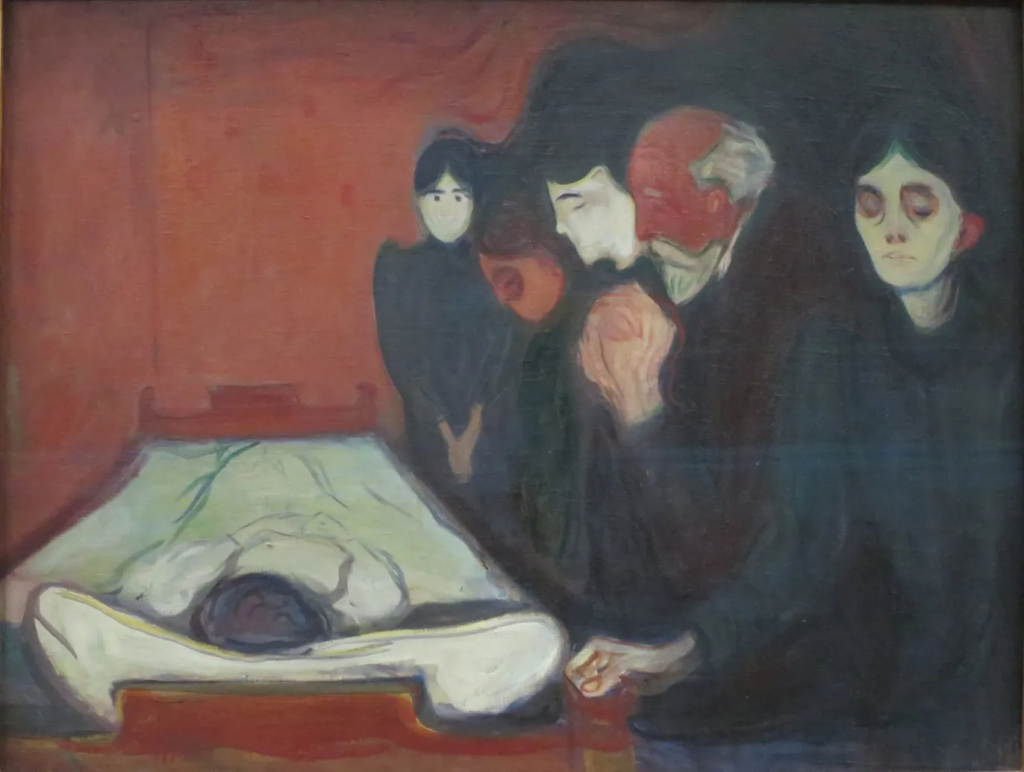
By the Deathbed (1895) by Edvard Munch
Dying might go on for a while, but dying only happens while we are still alive. When we are dead, it’s all over. Assuming there is no afterlife, there is nothing more. There are no memories, no hopes, no pains, and no dreams. We won’t even be aware that we are dead.
Death, therefore, is nothing to us.
— Lucretius
Belshare shares a fairy tale where two young lovers enjoy a candlelit dinner. Jazz band, Champagne, oysters. A first kiss. After their romantic rendezvous, they drive home, but the young lady loses control of her car and hits a bridge. She is killed instantly before she is even aware of what has happened. She dies without pain, and she experiences no fear.
The young lady’s death brings sadness to her family and friends. Relatives bring flowers to her funeral, and her lover sheds many tears. However, the young lady knows nothing of her death. Did anything bad happen to her?
Most of us will say, “Of course! She had her full life ahead of her. And now she is gone.” Isn’t that obviously bad?
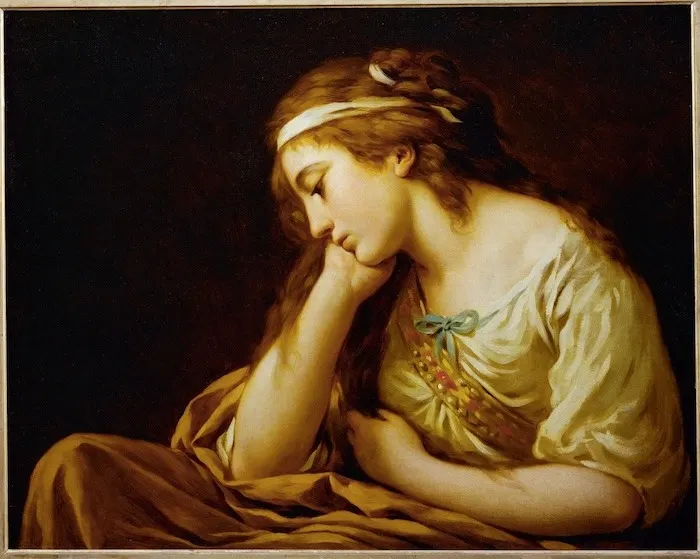
La Melancolie (1785) by Louis Jean Francois I Lagrenee
Epicurus and Lucretius argued that death isn’t bad for us after all, and we shouldn’t be afraid of it. They both believed the world is made of particles (long before scientists discovered atoms) and after we are dead, we go back to being particles once more. Being dead means nothing to us because we no longer exist. If Epicurus and Lucretius are correct, it’s wrong to say that this young woman is harmed in any way. She had no fear or anxiety, and she did not suffer at all. Her family mourns her death, but she knows nothing about any of this (Belshaw).
What obligations does the deceased’s family have? Before you die, you tell your family, “When I die, I’d like to be buried on the edge of the woodland in a cotton shroud with a small choir singing English folk songs.” Your family promises to satisfy your wishes, but what happens if they break their promise? Who will be hurt? Keeping the promise pleases no one, and breaking the promise hurts no one, either.
You should make those plans anyway, even if your wishes might not be followed. If your family decides to ignore your wishes and sends your body for cremation, there’ll be no one to be bothered. But if your family does decide to celebrate your life, they won’t have the burden of worrying how. They’ll just have to buy that cotton shroud. Extra bonus: if they follow your wishes, you won’t end up in an expensive mahogany coffin with a plush velvet interior that costs twelve thousand dollars.
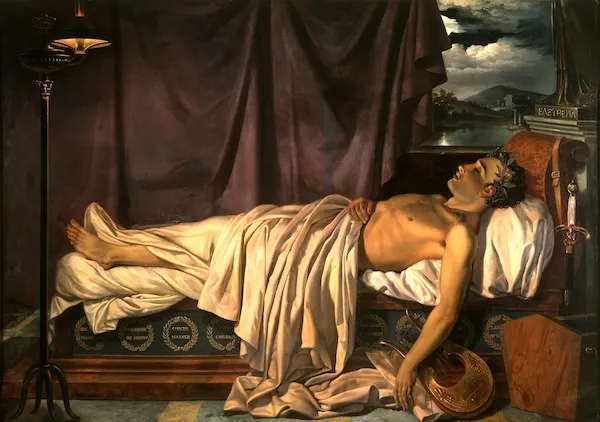
Lord Byron on his Death-bed (1826) by Joseph Denis Odevaere
C.S. Lewis wrote about the death of his wife in his memoir, A Grief Observed, and I have often wondered whether mourning is easier for Christians who believe in an afterlife. Is it easier to accept the death of a loved one if you are sure that you will meet again? Lewis says it is not.
No one ever told me that grief felt so like fear.
― C.S. Lewis
A Grief Observed begins with the unbearable pain that came from losing his wife (he refers to her as H.), then takes us through his changing emotions as he comes to accept her death: still suffering in each phase of grief, but suffering in a different way.
By the end of the book, Lewis still feels her absence — “like the sky, spread over everything” — but where once he felt that he shared his body with his lost lover, now his body is just an empty home.
He takes us through the stages of their loss — through dying, death and mourning. Even when H. is dying of cancer, they still share the joy of living together; their joy continues to flow even when all hope of living is gone. After she passes away, Lewis contrasts the joy of living with the grief of being without her. According to Lewis, the one who survives will never understand what it is like to be the one who dies — this much is true. But he also asserts that it will always be worse for the one who dies, but I think he has this wrong. In the tragedy he describes, where the lovers have time to prepare, it is so much harder for the survivor to understand what it will be like to live alone, while the other has nothing to do but die. It is harder for those who will grieve.
But that grief does not stay the same forever.
What does it matter how this grief of mine evolves or what I do with it? What does it matter how I remember her or whether I remember her at all? […]
Already, less than a month after her death, I can feel the slow, insidious beginning of a process that will make the H. I think of into a more and more imaginary woman. […]
But won’t the composition inevitably become more and more my own? The reality is no longer there to check me, to pull me up short. […]
What pitiable cant to say ‘She will live forever in my memory!’ Live? That is exactly what she won’t do. […]
What does it matter how I remember her or whether I remember her at all?
— C.S. Lewis
Lewis’ mourning begins with a cry that his pathway to God was shut and bolted by his loss, but later, he wonders if it was his own need for grief that slammed it closed. This might be true, too, for those who need help from their family — While our grief is fresh, we have to suffer it alone, and we have to re-learn how to ask for help.
The time when there is nothing at all in your soul except a cry for help may be just the time when God can’t give it:
— C.S. Lewis
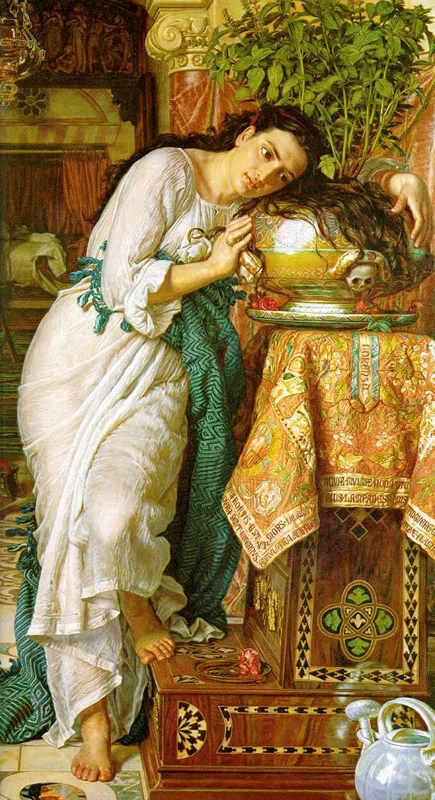
Isabella and the Pot of Basil (1868) by William Holman Hunt
Most of us don’t understand what a complex business it is to die. The agony of preparing to die can be hard, but it’s harder for those who will be left behind. In addition to visits to the hospital, your family has to learn to pay the bills and figure out where the money is hidden. Of course, if you die suddenly, you have none of this to deal with. But if you know what’s coming, you can be ready, and you can share your ability to know the future with your family, so that they can know, too.
Then you can share in the joy of living.
If I should leave you Please try to remember the good times Warm days filled with sunshine And just a little bit of rain
— Fred Neil
Christopher Belshaw (2005). 10 good questions about life and death.
Bernard Williams (1973). Problems of the Self.
The Holy Bible: King James Version.
Lucretius (Ancient Rome). De Rerum Natura (On the Nature of Things).
Epicurus (Ancient Greece). Letter to Menoeceus.
Thomas Nagel (1970). The Possibility of Altruism.
Tacitus (Ancient Rome). Agricola.
Nick Drake (1969). Riverman.
C.S. Lewis. (1961). A Grief Observed.
If you enjoyed this post, maybe share it with a friend?