

Is Reality a Social Construct?
Once a month, I go to Café Philo at the pub. None of us there is a philosopher, but we do enjoy going to the pub, and we enjoy arguing about philosophy. This month’s topic was: Is Reality a Social Construct? I almost didn’t go because I wasn’t feeling well, and the topic didn’t sound very exciting, but I am glad I went. Best discussion so far!
None of us knew much about the topic, and we started by not agreeing about much at all. We began by talking about what we meant by reality, and we immediately disagreed over that, too. Can something be real if you can’t see it or touch it? Is an agreement with your friends a reality? We agreed that things need to exist to be real — chairs are real, but unicorns are not — but do you need to experience them? We disagreed over that. We know chairs are real because we can touch them. But electrons? I’ve never experienced one. Or llamas.
Someone suggested that perhaps there’s a civilisation that has never seen a chair. Would chairs be real for them? We decided that the chairs would still exist, even for people who don’t know what they are. We can show them a chair and say, “This is a chair,” and they’ll say, “Oh, yes. A chair.” They’ll understand that chairs were real even before they saw one.
So chairs are still real, and unicorns are still not real. Because… why? I’m not sure. What if we just haven’t seen a unicorn yet? When did the unicorn become not real?
Someone suggested that an opinion like “this cup of tea is delicious” represents reality for the person who holds it, but we didn’t agree on that. One extreme said the opinion represents reality for the person who holds it, even if others disagree. Others said that a single person can’t create reality just by having an opinion, but perhaps if everyone agrees… perhaps that makes it real. Another said opinions don’t represent reality at all. Physical things like chairs are real. Opinions are not.
It’s not always useful to think of things as real or not real, and some things are more real than others. We came up with a scale that captures how real something is. The scale goes from “this thing is definitely real” to “that thing is definitely not real”, with lots of ground in between. We agreed that physical things exist at one end of the scale, and imaginary things go at the other end. But what about ideas like “this tea is delicious”? Where do they fit in? And what about money? Or the law? Are they real, or are they just things that some humans just came up with?
Here’s our scale.
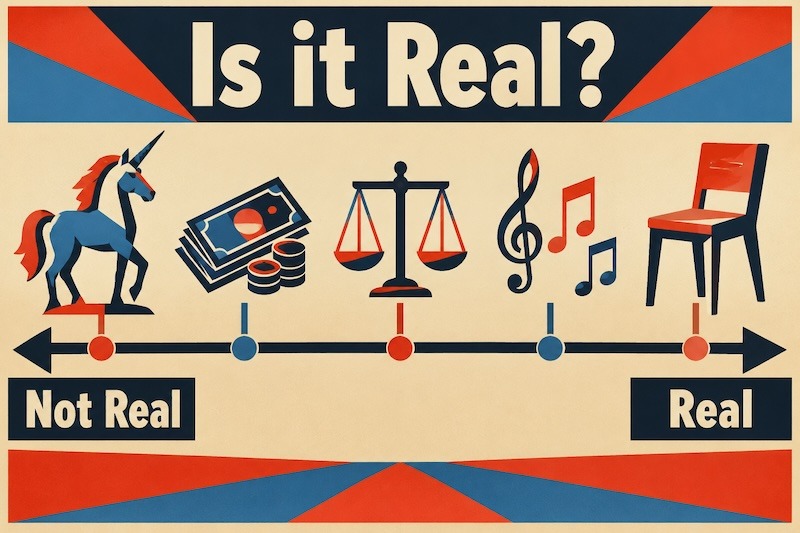
So, coins and notes are real, but is the money they represent real? We can see coins, but coins won’t be around for much longer, and then the currency will only exist on computers. Are things on computers real? What about Donkey Kong Jr.? Currency is only real now because we agree that it’s real. Does it remain real when we lose confidence in it, and it goes away? The Zimbabwean Dollar and the Yugoslav Dinar lost their value and disappeared from circulation. Are they still real? At what point were they no longer real? (We didn’t agree on any of these points)
Laws are tricky, too. What if we don’t agree on whether a law is correct? Does that law still exist? Some people just ignore some laws. For example, there’s a law against using your phone while driving, but most people ignore it. Is it still a law if no one follows it?
It was about now we decided that whether something is real does not mean it needs to exist in reality — one’s an adjective, and one’s a noun. We also decided that there are separate categories of ”fact” that can represent reality. Some facts represent physical things in the world, while others represent things in our minds or things we have agreed on between us. They are both real, but they mean different things.
I did a little reading this morning to see what the proper philosophers say about it. John Searle’s summary of the two kinds of reality agrees with what we came up with. Clever us!
Searle defines brute facts as realities that exist independently of society, language, or thoughts, while institutional facts are realities that exist when human communities collectively agree about them.
Brute facts are true whether humans acknowledge them or not. They include natural phenomena like the laws of physics, mountains, hydrogen atoms, or snow on a mountain.
Institutional Facts are built on human agreement. They require human institutions, culture, and collective agreement to exist and include things like love, laws and money.
We came up with the same categories of reality; we just had different names for them.
Back in the Stone Age, humans built huts and caves, but they are all gone now. We agreed they were real back then, but are they still real now that they are gone? I think they are real, but we didn’t agree on that.
There are even ideas that we all agreed exist, even if we don’t agree whether their reality is a brute fact or a human agreement. For example, we humans see colours out in the world, but do colours really exist out there, or are they something that humans create in our brains when light rays enter our eyes? Other animals can see colours too, but they see different colours from us. Are their colours still real?
And what about numbers? Is maths a brute fact or an institutional fact? Do numbers exist independently of humans, or are they just something we agreed on? The square root of 144 is 12, but is that something we invented? What about negative numbers and imaginary numbers? I don’t think they existed before we came up with them. Others disagree. Plato believed that mathematical concepts (according to Gemini), like circles, triangles, and numbers, are eternal, unchanging truths in a separate realm, but Aristotle rejected Plato’s realm and said mathematical objects have no independent existence. Mathematics is just something that humans do.
Even within the category of physical things, we still had some dispute about what belongs to reality. Chairs exist, sure, and carbon atoms, but what about quantum particles? There’s definitely something there, and we know what they do, but we don’t really know what they are. Do they really exist, or are they just something we have agreed on?
“Quantum mechanics describes nature as absurd from the point of view of common sense. And yet it fully agrees with experiment.”
— Richard Feynman
There were other areas of dispute.
Are ethics real? And do they come from human agreement like institutional facts are supposed to? For example, all mammals care for their babies. Searle said that it’s only an institutional fact if humans came up with it, but evolution gave us the rule to take care of our babies about 200 million years before humans came along, so maybe that one is a brute fact. There are plenty of other rules and morals where it’s ambiguous when or whether we invented them. We disagreed noisily over whether slavery was immoral for the five thousand years before we agreed that slavery was immoral. Perhaps there are moral rules that exist, even if we haven’t agreed on them yet.
Does god exist? Most people are sure that either He does or that he doesn’t. Perhaps we will only know the true reality when we go off to meet our maker.
Beethoven’s Symphony No. 5 provides a different kind of challenge. Does Beethoven’s 5th come and go, depending on whether someone is playing it? Or is it there all the time? Does it only become real when an orchestra is playing it in a concert hall? What if someone is just playing the intro on a violin? What if it’s just on a CD or if the score is written on a music sheet? Do they all count as Beethoven’s 5th? We agreed the symphony is real, but we don’t agree on what makes it real or even when it’s real.

I’ve never given the topic of reality much thought, but we had a cool mix of new people and old people at our table last night, and it was a pleasure to discuss it. We still didn’t agree on much by the end, but we ended up closer than we began. It was a great discussion.
We go to the pub for Café Philo every month. Some of us have been coming month after month, and some are coming for the first time. There’s no expectation that we will agree on anything, but as long as we get our thoughts out there, it’s all good.
Leave a comment below if there is something you disagree with.