But do I really know?
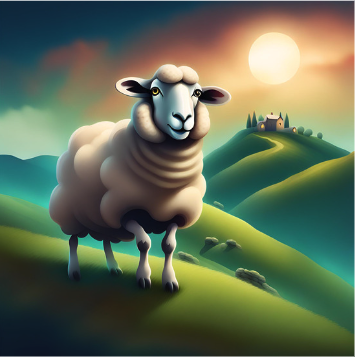
I’m looking out my window and I see a sheep on the hill across the harbour. I believe there is a sheep on the hill but do I know it?
Until recently, philosophers would have said that there are three conditions that need to be met before a belief can be considered knowledge.
First of all, I have to believe it. If I don’t believe there is a sheep on the hill, then I certainly don’t know it. Duh!
Second, it has to be true. If that sheep is not actually a sheep — if it’s actually a dog that looks like a sheep — then I don’t really know it after all. I believed it, but I was wrong.
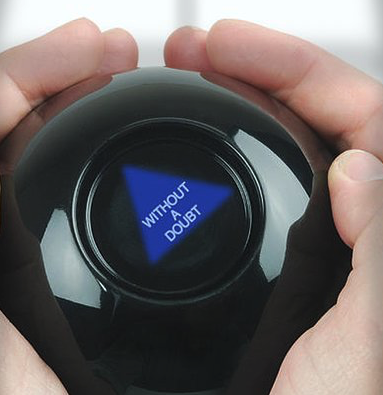
Third, my belief has to be justified. Let’s say my curtains are closed and someone asks me if there is a sheep on the hill. I consult my Magic 8 Ball and it tells me ‘Without a doubt’, there is a sheep on the hill. Does my Magic 8 Ball justify my belief? Of course not. My Magic 8 Ball is not a source of knowledge and I am not justified in believing what it tells me even if what it tells me is true.
In summary, a belief counts as knowledge if it is a justified true belief — or just JTB for short.
JTB was the standard account of knowledge until the 1960s when Edmund Gettier found some scenarios where a belief is true and justified but doesn’t count as knowledge. Let’s go back to my sheep.
I’m looking out my window and I see a sheep on the hill across the harbour. I say ‘There is a sheep on the hill and I know it’.
But! It turns out that the sheep is actually a dog that looks like a sheep. It’s not true.
But, wait!! There is actually a sheep that I couldn’t see — it’s right behind the dog. There IS a sheep on the hill, just not the one I thought I saw. I knew there was a sheep on the hill!
According to Gettier, I did not know that there was a sheep on the hill. My reason for believing it was justified, even though my evidence turned out to be false. My belief was justified and true but it was not knowledge because it was only true by a lucky coincidence. According to Gettier, this shows that the justified true belief account of knowledge is insufficient. Gettier came up with several problems like this (he didn’t actually come up with the sheep problem but Gettier’s scenarios are horribly contrived and convoluted). These problems are referred to as Gettier Problems. These problems have kept philosophers busy for the last fifty years.
Here’s another example.
Imagine that we are seeking water on a hot day. We suddenly see water, or so we think. In fact, we are not seeing water but a mirage, but when we reach the spot, we are lucky and find water right there under a rock. Can we say that we had genuine knowledge of water? The answer seems to be negative, for we were just lucky.
(Dreyfus in Stanford Encylopedia of Philosophy)

According to the Stanford Encyclopedia of Philosophy (SEP),
A lesson of the Gettier problem is that it appears that even true beliefs that are justified can nevertheless be epistemically lucky in a way inconsistent with knowledge.
(SEP)
SEP says that our choices are to either accept Gettier’s challenge and look for a fourth condition to add to JTB or to challenge Gettier’s claim that the beliefs in Gettier Problems are actually justified.
For me, the idea that my belief that I saw a sheep was justified because I saw a dog that looked like a sheep is, to use philosophical terminology, absolutely nuts. Likewise, ‘mirage in the desert’!? Everyone knows not to trust a mirage. In neither case was the belief justified and, according to me, Gettier is wrong. The lucky beliefs in Gettier Problems are not justified and JTB survives as a sufficient account of knowledge.
But what does it mean for a belief to be justified?
Put Gettier problems to one side for a moment and think back to the simple case at the top of this post. When I mistook the dog for a sheep, my belief wasn’t knowledge because it wasn’t true. So was I justified in believing something that was not true? I thought I had evidence to support my belief but the evidence turned out to be wrong. I maintain that my belief was not justified. I needed more evidence to be sure.
So how much evidence do I need to justify a belief?
Philosophers are pretty much resigned to the idea that we can’t be 100% certain of any truth except for a few exceptional cases such as geometry and things that are true by definition (like, all bachelors are men). Even if I saw a million white swans, I couldn’t know for certain that all swans are white because someone might nip off to Australia and find me some black swans.

The best that we can hope for is to have enough evidence to justify a belief for now and we can revisit our belief if some new evidence turns up later. Let’s call it ‘provisional knowledge’. Maybe all knowledge is provisional?
But how much evidence is enough?
I don’t get to make the rules but I like the standard used in criminal law: to convict someone you have to have evidence beyond a reasonable doubt. Sometimes, the court gets it wrong because they were mistaken about the evidence — like, they thought the dog was a sheep or the witness saw a mirage — but if they do get it wrong, they go back and retrospectively admit that their belief was not justified. Philosophers should do the same.
Gettier Problems are not problems. Knowledge is justified true belief.
Yes! Love the nice simple examples. I agree. 😊
Thank you, Justine! I often wonder if I am the only one!
I’ve had a few goes at philosophy down the years – (particularly Schopenhauer and Wittgenstein) but always recoiled from the impenetrable prose of the discipline. (The least-worse experience I’ve had was Bertrand Russell’s ‘History of Western Philosophy’).Anyway to get to the point of my comment….thinking about philosophical abstactions like belief has often brought on this little thought-experiment: supposing you could eliminate all words from a consciousness (every single one including ‘word’ ‘all’ consciousness’ ‘universe’ ‘existence’ ‘belief’ etc etc etc) what would be left in the universe? Nothing? (not even ‘nothing’ infact?
It’s weird how many philosophers suck at writing. Like they are deliberately obscure. Bertrand wrote very clearly in my opinion. So did Wittgenstein. Schopenhauer, not so much.
I think my little dog has no words but I think she is conscious of the universe.
I totally agree 🙂
Hi Kevin. I think it’s time to hear some examples of synthetic facts that you think you can know. I think it would be helpful in seeing what sort of position you are holding. Where does this level of reasonable doubt lie.
In the court case, there might be new evidence that comes to light in a retrial, but it is the True part of the JTB that they are refuting. The court can and often does think that they were justified in the original prosecution. I also think this argument might show a contradiction in thinking of justification as being beyond all reasonable doubt.
P1. Justified means beyond all reasonable doubt
P2. A is found guilty beyond all reasonable doubt.
C1. Therefore, A was justifiably found guilty
P3. New evidence is found that shows A is innocent
C2. Therefore, A’s guilty verdict was not justifiable
C3. Therefore (P1&C2), A’s guilty verdict was not beyond all reasonable doubt.
P1 & C3 are a contradiction. Let me know what you think.
The True part did not change during the retrial. A either did the crime or they did not. This is true during both the original trial and the retrial. The J relates to how much evidence you have.
C1 was provisionally sound but the second part of the argument takes place at a later time. At the time of the second part of the argument (the retrial), your new evidence shows that P1 is not (and was not) true. You thought the conviction was justified but you were mistaken. There is no contradiction.
Criminal Law has a mechanism for revisiting bad reasoning or for correcting invalid premises. All convictions are provisional and can be corrected if new evidence comes to light. The same is true in science. If your geocentric model of the solar system disagrees with the data, the model is incorrect and you need a new model.
The same should be true in philosophy. Knowledge is provisional.
I agree with everything you say, but the element the court got wrong in the first instance was the T part of JTB. They had false knowledge or thought they knew but in fact didn’t.
Now, on the question of is knowledge provisional, then yes I think so. We should always be willing to accept new evidence that challenges our beliefs, but we must act and change our beliefs if we are warranted in doing so. But if we are shown to be wrong then it isn’t necessarily the justification that was the error (it might be if we had no good reason for the belief) it can also be the truth and the falsity of the knowledge does not automatically mean it was poor justification.
I am 100% sure that I think therefore I am. I am not so sure that I have hands though because an evil demon (or The Matrix) might be fooling me.
I believe beyond a reasonable doubt that I have hands. I know it provisionally but I’ll update my belief if new evidence comes to light.
I am 100% sure that, in Euclidian geometry, the angles of a triangle sum to 180°. I am sure of this because Euclid designed the system so that it is inevitably true. But synthetic facts are not inevitably true in the real world. We should hold them lightly and be open to new information. On the surface of the earth, angles in triangles do not sum to 180° because, it turns out, the earth is not flat.
Would you say you know you have hands?
All the evidence supports my belief that I have hands. The Matrix hypothesis and the Evil Demon hypothesis are not plausible. My belief is justified beyond a reasonable doubt. I know I have hands.
It it were later to be shown that you don’t have hands, was the original knowledge show to be false, unjustified, or both.
If it turns out that I don’t have hands – perhaps they are an illusion created by an evil demon – then my belief was false and the evidence that I had hands was insufficient to justify my belief.
Nicely explained.
Well stated. I can see how this would take 50 years worth of debate.