

Should computer science students learn the arts?
On Twitter, @xphilosopher asked,
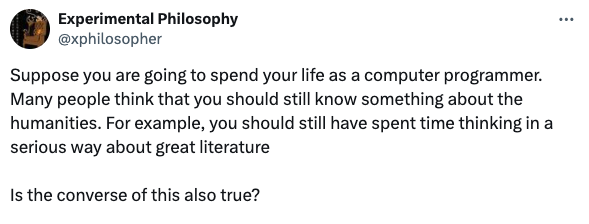
English universities are very different from American universities in this regard. If you study computer science in America, you do a four-year degree and about half of that will be spent learning literature, history and Pre-Raphaelite paintings. If you study computer science in England, you’ll spend three years studying computer science and nothing else.

In the last two years of school, English kids focus on three subjects at A-Level which will typically be all STEM or all humanities. Even at O-Level (14-16), I dropped everything (except English literature) that wasn’t maths, science or a language.
If you want to study biology at Cambridge, we expect you to be good at biology. We don’t care what you know about history.
a recruiter at Cambridge University
That’s as it should be.

Because of this, my American friends often assume that English folks who study science at university know nothing about the humanities but this has not been my experience at all. Your average English programmer knows quite a bit about literature and history while your average American programmer barely goes beyond science fiction and the American Civil War.
I remember being shocked in the Bush years that many of my American colleagues had no idea where Afghanistan or Iraq were. Radiolab did a segment once where they interviewed Americans in the street and no one knew what gonads were.
If the point of a liberal arts degree is to give people a rounded education, it’s not working.

In America — as in England — the most curious folk feel an urgent need to learn everything about everything and end up knowing all about monotremes, Catherine the Great and the Tao Te Ching. But most people are just not interested and four years of university doesn’t seem to make much difference.
Thinking about this from the other direction, 16-year-old me wanted to study maths, maths, physics and chemistry. If you’d made me study history or art, I would have quit at the first opportunity.
Don’t get me wrong: I love history and art and study them still but the stuff they wanted to teach in school was just plain boring. If you’d made me learn about the Spinning Jenny and the Corn Laws, I would have become less interested in history, not more.

More seriously, my kids went to school in California. My daughter struggled with the language requirements for the University of California but she just graduated top of her Master of Arts class at the University of Bristol. No languages required.
My son dropped out of UCSB because he couldn’t bear to learn about the American Revolution (again) or organic chemistry (again). He’ll get his degree soon though because when you are learning environmental science over here, they expect you to learn environmental science — not Shakespeare or Renaissance art.

Of course, some kids don’t know what they want when they are eighteen and others want to explore everything that is on offer. For those kids, a liberal arts degree is perfect but for a kid who is a genius at physics and maths, it’s just a distraction. The American insistence on a rounded education prevents a lot of kids from studying the topics they love.

I knew what I wanted when I was 16 — I wanted to study engineering — but I never stopped reading literature or learning history or genetics and now that I am approaching retirement, I’m back at university studying philosophy and classical Greece.
I think the people who design liberal arts degrees in America should wonder why so few people are still interested in the arts after they graduate.
It’s a business. Universities, both directly and indirectly, get paid for how long you are studying there. So stretching it out brings in $. btw I did the same A levels at Chis and Sid as you
I actually bailed at 16 so I never got to do my four A levels. When were you at Chis and Sid, Bernard? Where did you end up going to university?
Another difference between the UK and the USA: most people doing a three year degree over here finish in three years because most of their classes are prescribed by the university.
In the USA, you choose your classes as you go along and if the class is full, no class for you 😟 Only 45% of American kids finish in four years. Only two thirds finish in six.
I agree with you about US and UK universities, but what I have noticed recently is a shift over here. So in America then a first degree isn’t worth anything. You have to go and do a Masters degree to get anywhere.
In the UK a degree used to be worth something. When I got my 2.1 in 1994 I was in the top 10% in the year. But only the top 8% got a First. I still get dinged for that 2.1 in interviews.
There was a recent article saying that now 80%! of students in the UK now get a 2.1 or a First. Which means that they’re not worth anything. And I’ve noticed that the last couple of OU modules that more and more people are going on to do and Masters degree. None of my old university friends have Masters degrees. They were seen as a stepping stone to a PhD – not a requirement for working.
It is a mystery! Grade inflation sucks for everyone.
One possible explanation is that universities have become more like vendors where The Customer is Always Right. If the university does not give the student the grade that their parents want, the parents will send their child somewhere else.
Another explanation is the growth in international students. I have it on good authority, for example, that many students from China do not have the basic qualifications to attend university. Many can’t even speak English and they buy a fake certificate that says they can and also that they are very smart. Not all students, of course. But enough to persuade the universities that they must pass these foreign students or forgo the £18,000 that they bring with them. And, if they pass the Chinese students, they must pass the British students too.
Grade inflation definitely sucks for everyone. The smart kids feel hard-done-by and the not-so-smart ones get jobs that they struggle with and the employers, who get 1000+ CVs for every job, have to distinguish the wheat from the chaff somehow. But that’s where we are.