

A Good Death
Imagine you are in terrible pain and you are dying.
At the end of your street is a facility, A Final Farewell, that offers you the option of a good death. You’ll need confirmation from your doctor that you are really dying, and a second doctor will interview you to be sure you know what you are doing and no evil son-in-law is coercing you. You can change your mind at any time.
On the special day, you head down to A Final Farewell with your wife and family, and they have a beautiful room prepared for you. You hang out for a while with some close friends and say goodbye. You enjoy an entrecôte steak with your family and a lovely glass of Fuller’s Vintage Ale, and then it’s time.

A Final Farewell has prepared a bench for you under an old oak tree surrounded by daffodils and primroses, and the sun is shining. Claude Debussy’s Gymnopédie is playing softly. You have one final hug with your wife, and she whispers, “I love you so much. Safe travels.”
You drink the glass of medication that has been prepared for you and your life on this earth is over.
There’s no obligation to choose to leave your life this way. Palliative care is like a miracle for many people. For many conditions, palliative care can make all of your pain go away — but this doesn’t work for everyone. And even if there is pain, some patients will prefer to bear it. Other patients go into a coma that lasts for weeks and months while their family cleans them and turns them to prevent bed sores. You will still have all of these options, even if the option to choose your own time of death.
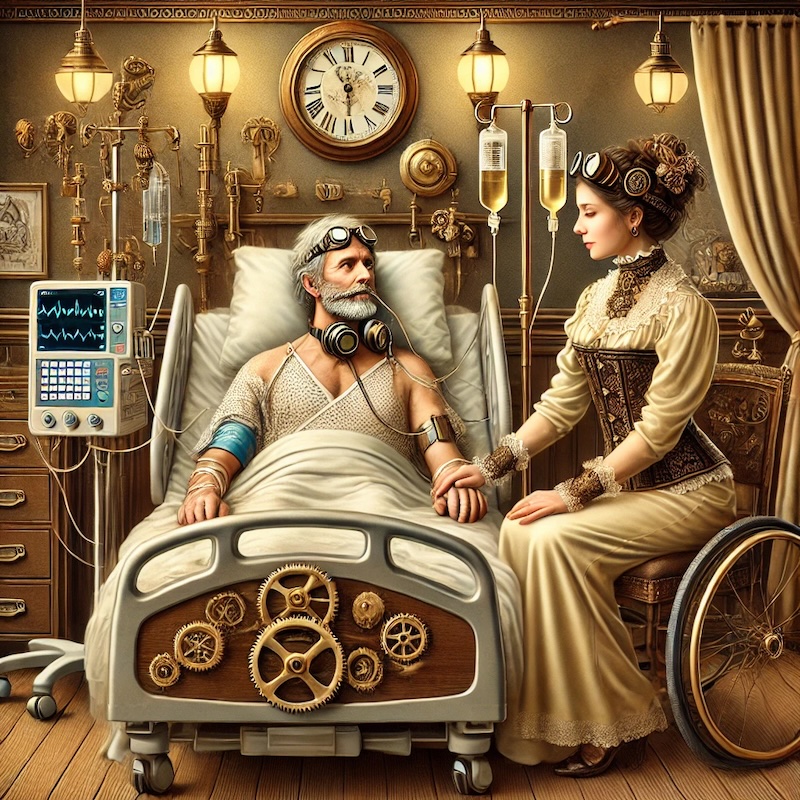
The bill to be debated in Parliament will give us the choice of a good death when our suffering becomes too much. I will choose palliative care for myself, but I will be grateful for the choice of a good death if palliative care is not working for me.
These are not the only options, of course. If you are in a coma, you can already leave instructions for your nursing team to starve you to death. Dying of thirst is another option that many people choose, and if the pain becomes unbearable despite palliative care, your doctor can increase your morphine until it kills you.
Dignitas in Switzerland offers the opportunity for a good death but if your wife comes with you to comfort you she will be investigated for assisted suicide. Prosecutions are rare but your wife will be investigated by the police and probate will be held up until she is cleared. You must go to Dignitas on your own.

Suicide is another option. You can connect a pipe to the exhaust of your car. But again, the law says you must die alone.
There will be restrictions on who can choose assisted dying under the new law. It will only be available to those who are already dying. It will not be available to the disabled, neither will it be available to people with depression or other mental illnesses such as dementia.
The courts in Canada have demonstrated the perils of a slippery slope and have changed their Medical Assistance in Death law several times to widen the scope of their law but the assisted dying law in Oregon has not changed in twenty-five years.
There are several options open to you if you are dying in pain but the new Assisted Dying Bill offers one more.
What would you choose if you were given the choice?
Would you choose a good death?
Credit to Nigel Warburton for the idea for this post.
Yes
Applying for my passport soon which will be good for ten years so I can head to Switzerland when needed.
Vermont USA accepts non-residents for MAID, but they are a small state and are overwhelmed with requests as of fall, 2024.
Nice to hear from you, Claire.
I believe Oregon’s supreme court has just decided that non-residents are eligible.
Let’s hope that none of us need it for a while!
Yes, Oregon is open to non-residents too, but the process is cumbersome and not encouraging.
Good to hear from you
Hoping for many more days to come for all of us
For myself as for any creature here on earth I would wish a Good Death.I think any being has a right to decide that and document that decision and it should be honoured by family, nearest and doctors. If a doctor has conscience problems, they should direct someone to a doctor who can help.
Yes, everyone should have a choice. I believe doctors will have the right to refuse.
Thank you for this post. It’s such an important issue that doesn’t get enough attention. When I was diagnosed with cancer, my biggest fear was living a life I didn’t want to live, with no way out. When it was my beloved shih tzu’s time to go, she left with dignity. Can’t humans have the same?
It is so important, Danielle.
I have been shocked at how dishonest so many of the arguments from politicians and journalists have been. It’s like they have forgotten what the bill is about.
Somewhere online this morning I read that physicians can be asked to put in writing their position on MAID, either pro or con. That would eliminate confusion as the time draws near.
I will be printing out the necessary forms to donate my body to a nearby university with a criminology program. Research is conducted on dead bodies that are allowed to decay without preparations for a formal burial. As a gardener in love with digging dirt, composting, and worm composting, I have dreamed of decomposing in a very natural way.
You’ve put a lot of thought into it, Claire!
I know that doctors here and in most jurisdiction have the right to refuse to be involved. In England, they will have to refer the patients to another doctor.
“The good death” is a wonderfully reassuring thing for patients to have in their back pocket in case the going seems certain to get too rough.
I know people in the US who were approved and never used it. I know a few who set a date and used it. In the US, one must be able to prepare and take the meds by oneself with no assistance, which means timing of the event is key.
All were glad to have it available to them. (It is not available in all states.)
I want it available. It’s hard to imagine the circumstances that might drive me to use it. Nonetheless, I want the option; and it is available to me without needing to relocate or visit a different state.
I hope it becomes available in the UK. Blessings to all who consider it for themselves, and to all who don’t deny it to others.
I read today that 30% of people in Oregon who requested it ended up not taking it.
The English law requires that you take the medication yourself too. I think that takes away the opportunity to plan ahead but it is understandable why they want to have it that way as a safeguard.
Blessings to us all!
“The courts in Canada changed their Medical Assistance in Death law to widen the scope of their law but the constitution in England and Wales does not allow this.”
A couple of friends have asked why this is so.
In Canada and the USA, the courts can overrule the Parliament/Congress. In fact, this is how the MAiD law came about in Canada. The court said that the parliament must pass a law.
It’s also why the law has been expanded to include mental illness, handicapped people and anorexia. The Canadian court said that it was unfair to restrict the law to people who were already dying. This can’t happen in England because Parliament has supremacy over the courts and the law is restricted to people who are already dying.
Of course, there is nothing to stop a future Parliament from expanded or restricting this law because no Parliament can restrict a future Parliament. But that’s true whether they pass this bill or not.
Everyone has their own beliefs and I am definitely a believer in being able to die with dignity if given the opportunity and would definitely choose a good death when the moment is right.
I think choice is so important, Di. No one should have to die in terrible pain or live with a loss of dignity.
There is only one person who decides when we die!
In Vermont over half the people who use MAID have cancer. There is an annual report of statistics online.
From How to Die: An Ancient Guide to the End of Life, Seneca, translated by James S. Romm
“But if one’s body becomes useless for performing its functions, is it not fitting to draw the struggling mind out of it? And perhaps the deed must be done a little before it ought, lest, when it ought to be done, you’re no longer able to do it.”
Don Schlitz wrote this song when he was 23 years old:
You’ve got to know when to hold ’em
Know when to fold ’em
Know when to walk away
And know when to run
You never count your money
When you’re sittin’ at the table
There’ll be time enough for countin’
When the dealin’s done
I am saving this, thanks for posting it here.
You are welcome, Janet!
I highly recommend Romm’s book, How to Die, which actually focuses more on How to Live. It is a small book. It would be a quick read if it weren’t packed with such good ideas.
I will look up the Romm book, Claire, thanks for the recommendation.
You are very welcome, Janet!
By the way, after I read How to Die, I was curious about Seneca’s life in Ancient Rome. So I read his biography, Dying Every Day by James Romm. It was a real page turner because those Romans would do anything, even to immediate family, to stay in power. Seneca’s actions are questioned in the book.
Another to look up, I shall read all three during these gloomy months and hope they bring additional clarity to my thinking on all of this. Thank you. You’d make a great librarian!
I love libraries and librarians! You are right!
I live in Oregon and lived here when the “Death With Dignity” law was enacted. I also remember later, when the local newspaper published a series of lengthy articles with photographs documenting the decline and cancer death of Dr. Peter Rasmussen, the oncologist in my town who had worked on and promoted the law. It was fascinating in its candor and especially because he was able to talk about the law from the perspective of the dying person using the law he had helped create.
Since then I have been two degrees of separation from a few people who have died under the provisions of the law, have also been similarly related to some who wanted to use it but their ability to self administer evaporated unexpectedly or declined more quickly than expected and so were not able to. E.g., One night they were still able to lift something to their mouths and the next morning they could not, or one hour they could ask for assistance setting the final procedures in motion, the next hour they could not, or at breakfast they could carefully and slowly swallow a few sips of something, but by lunch they could not. For some, they waited too long to initiate the paperwork to set it up, or the multiple steps required took longer than they expected and they didn’t have everything in place yet at the time they could have or would have used it.
In order to pass the law in the first place, proponents had to make many concessions to opponents, so many that it is too restrictive for my liking. Attempts to broaden it or make it more accessible to people when they reach the very stage of their decline at which they have expected to ”want out” and do want out, have not been successful.
I am not ill. But I think about this a lot. I was greatly relieved to read about Canada’s law and the Swiss program, but I am not Canadian and I am still trying to figure out how I could get to Switzerland at just the right time in my decline —-far enough along that I don’t want to continue but early enough that I could make the trip.
Why can’t everyone be given a prescription for a lethal dose of morphine at the time of diagnosis and be left to fill it or not fill it at our discretion, to use with or without assistance? Some would choose to use it immediately, some would simply be happy to have it there for decades if they successfully pursued treatment or if their illness progressed slowly and without significant distress.
I know, there are many arguments to be made against that, all the “yeah, but what about”s. I haven’t read any that swayed me on this.
It should be easy to help those people who are ready to die without making it so easy that other people cannot be persuaded by family or culture or The System that it’s time for them to die. There’s a fundamental conflict there that is not going away.
It is a risk I think I would be willing to take in exchange for the right to exercise free will under a law giving the ailing person the right to choose their path. If I have misjudged my family members and others who know me, that would be sad, but I would be willing to take that chance. And if some organization somehow connived or coerced me into taking the out sooner than I wanted…well, I think I am still willing to accept that risk. But I will continue to contemplate and read about it.