
Philosophy at the Open University
I just submitted my very last philosophy essay. Hooray!
A few people on Reddit have asked me about my philosophy degree while they make up their minds on whether to study it themselves. I thought I’d collect some of my thoughts here, and maybe someone else will find them useful. Here goes…

Studying for a degree at the Open University
The first thing to know is that the OU doesn’t have a pure philosophy degree. You have to combine philosophy with another subject. This isn’t unusual, and plenty of other universities do this, including Oxford. I would have preferred to do straight philosophy, but I am happy with the way it worked out. I did classical studies as my other subject, and have enjoyed that too.
You have several choices for the ‘other subject’. I have friends doing PPE (politics, philosophy & economics), classics, religion or psychology as their second subject. You can also do a humanities degree, where you do a little of anything you fancy from the humanities. You could even do an open degree and mix your philosophy with science or maths, or whatever. You are not committed to the degree you start with and can always change your mind.
To graduate, you need 360 credits. That’s six modules of 60 credits each, with two modules at each of levels one, two and three. You can do 60 credits per year (part-time) or 120 credits (full-time). Level one modules are fairly simple and ease you into studying — especially if you haven’t studied for years — but they get more difficult quite quickly.
Here are the philosophy-related modules I’ve done, with a few words about each.
A111 – Discovering the arts and humanities
I had fun with A111, even though it doesn’t have much philosophy. It covers a little of everything from the humanities. Literature, music, history, religion, poetry, etc, etc — about twenty topics in all. You do a different subject every week, then write an essay every month on the subject that most tickles your fancy.
The chapters about Plato and Mary Wollstonecraft were cool, and I did surprisingly well writing a criticism of a Van Gogh painting. I loved the poetry too — that has never happened before!
A113 – Revolutions
A113 covers four topics — music, history, philosophy, and religion — but for every assignment, you get to choose which subject you write about. I chose philosophy every time.
The history & religion topics are interesting, and they do a good job of weaving all the topics together. The music chapters were horrible.
A222 – Exploring Philosophy
A222 was like a grand tour through 2500 years, meeting all the famous philosophers: Hume, Plato, Locke, Kant, Rawls, Descartes and more.
There are six books, each covering a different topic, with an essay to write at the end of each book. I loved Ethics and Political Philosophy. The others were Self, Knowledge (epistemology), Religion and Mind, and I enjoyed them all.
Philosophy of Mind was the reason I started this degree, but this was the topic that most disappointed me. The teaching was fine — I just don’t think philosophy of mind has much that’s useful to say. If you want to learn about consciousness, or thinking, or how the senses work, read some neuroscience instead. Suzi has the best blog on the internet about where philosophy meets neuroscience. Much better than reading philosophy of mind.
When Life Gives You a Brain
On neuroscience, consciousness, and artificial intelligence. Written for curious humans.
— By Suzi Travis
One thing I especially liked about A222 was that we could argue with the philosophers if we thought they were wrong. And most of them were wrong most of the time! Tutors are more interested in how you make your arguments than whether your arguments are correct, and it’s fun to go out on a limb sometimes.
I loved A222, but it has been replaced by a new module, DA223. I don’t know much about it, but I imagine it’s similar to A222.
A333 – Key questions in philosophy
A333 is more about learning how to do philosophy than learning philosophical ideas. In A222, you had room to think deeply about each topic and write what you thought about it. In A333, you read what someone else said and had to summarise it.
As with A222, all the topics were interesting. Most of the philosophy is quite modern (last 30 years or so), with a little bit of Plato and some Hume thrown in. Each topic has a few recent articles you have to read for ‘independent study’, and then you write an essay about them.
Truth in Fiction was about ‘paradox in fiction’ and ‘emotions in art’, and other topics related to literature or drama. It was interesting to read, but not really my thing.
There were two books on rationality and epistemology, which was maybe one book too many.
The Value of Life was about the topics that everyone imagines when they think about philosophy: Is life sacred?, What happens when you die? Is it good to be born? Does life have meaning?
When someone in the pub asks you,
“So, are you learning about the meaning of life?”
You can answer,
“Yes, I am!”
The book on War was about the Just War Tradition and the ethics of war. Who is allowed to kill whom? When is it OK to bomb civilians? This was the subject that felt most like real life.
Who hasn’t wondered about why we have wars and why you can kill some people but not others?
Assignments
In most modules, you get one assignment (TMA = Tutor Marked Assessment) every six weeks or so, with an extra big assignment (EMA = End of Module Assessment) at the end.
Weirdo that I am, I like writing essays, but the A333 essays were all a bit of a pain.
Where A222 gave you lots of room to express your own thoughts, A333 had you write about someone else’s thoughts. I found this annoying. In A222, I could take the argument in the direction I wanted to go — and sneak in the occasional joke — but I had to be all grown up in A333.

The OU has this crazy rule that you are not allowed to share your essays with other students. Ever. Not before the due date, of course — that would be cheating. But even after the due date has passed and everyone’s essay has been graded, you can’t share. This is such a shame because it would be a great opportunity to learn.
All through my five years with the OU, no one ever told me how to write an essay, and I had to figure it out on my own. It would be nice to see what other people are up to and learn from them.
Tutors
You get assigned a tutor for each module, but you don’t get to talk to them very much. They send you a big pile of books, and then you are on your own. You can email your tutor with questions, but my guess is that most students don’t even do that. I talked to my tutor for A333 a bit more — we even had a glass of cider together! But for most classes, we just talked about the assignments.
You’ll have the option to sign up for a few tutorials in PowerPoint, but you are on your own most of the time. There used to be the occasional face-to-face tutorial, where you’d all meet up in the nearest big city, but they did away with those.
I was lucky that all my tutors had philosophy PhDs. Even my tutors in A111 and A113 were philosophers — but that’s rare. All my tutors were very good. Two of them were excellent. Thank you, Dr I & Dr S!
Making Friends
I think the secret to having a good time with the OU is to find a bunch of students to hang out with, and I have a gang of around a dozen philosophy friends. We’ve been together for three years, and we talk nearly every day on WhatsApp. We even meet up for the occasional beer in London. I expect we’ll stay friends forever.
Most students study alone, and I imagine that to be lonely and depressing. Two of my modules had horrible WhatsApp groups, and I quit them. But even then, I found a study buddy in each module, and we became good friends.
There are forums in each module where you can discuss things with your fellow students, but hardly anyone shows up. It’s worth the effort, though — if only to meet people who will join you on WhatsApp.
What’s Next?
I read Zen and the Art of Motorcycle Maintenance about a million years ago, and that got me hooked on Plato and some histories of philosophy. I have been reading philosophy ever since.
In the last few years, I have been fascinated by the philosophy of mind, but A222 cured me of that. The chapter on John Rawls’ A Theory of Justice made me think I’d like to do a PhD, and show Rawls why his theory was all wrong, but after A333, I think I am done with academic philosophy altogether.
In A333, we got to see what proper philosophers do all day, and to me, it looks more like playing Sudoku than thinking deeply about topics. All the good stuff got done decades ago, and now they are just fiddling around the edges.
I’m still interested in philosophy, but I think I will enjoy it more when I am sitting in my armchair at home and drinking a glass of wine. If I had to do my degree all over again, I totally would, but I have had enough for now.
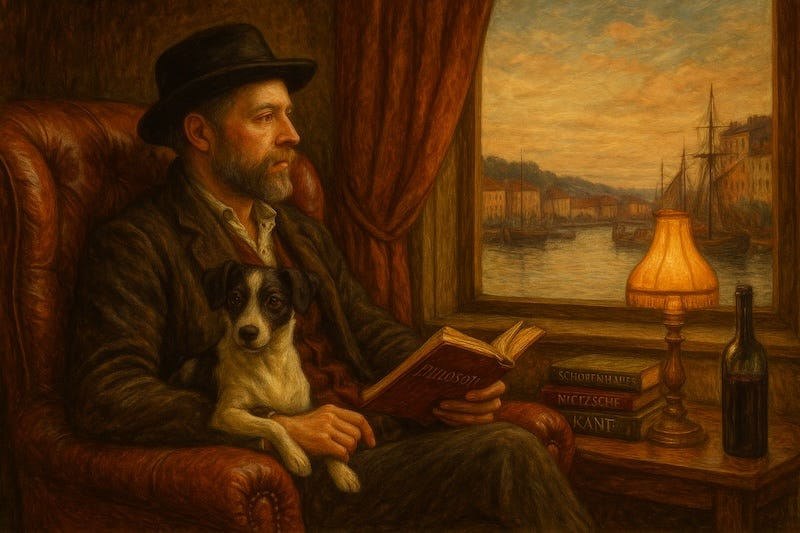
I left school when I was sixteen, but I always wanted to go back and get my degree. I have one more module on Greek and Roman Myth starting in October, and then I am done.