

Let the bells ring out!
I follow a bunch of cancer and healthcare hashtags on Twitter. This tweet caught me off-guard.
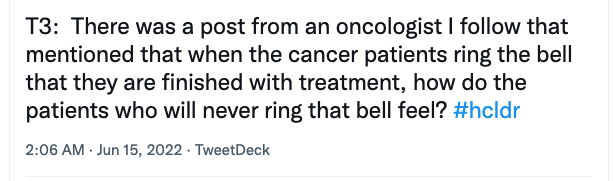
When cancer patients complete a course of radiation or chemotherapy, many clinics have a little ceremony where the patient gets to ring a bell and all the nurses and other patients clap and cheer to mark the end of one chapter in the patient’s life and the beginning of a new one.
There were a bunch of replies to that tweet suggesting that it might be unfair to publicly celebrate an event that many cancer patients will never get to enjoy. Here’s a gentle one:

A bit of googling shows that there are people campaigning to abolish the ceremony because of the distress it causes to those people who will never get to ring the bell.

On Smart Patients, folks often feel guilty about posting good news about their treatment out of fear of offending the folks who have no good news of their own. But good news posts are invariably met by an outpouring of joy and congratulations even from those folks whose own prognosis is bleak. Of course, selection bias means that the folks who do not find joy in other folks’ good news remain silent. It’s hard to get a true picture of who loves sharing joy and who finds only sadness in other folks’ triumphs. It’s easy to sympathise with Crazy Cancer Lady on Twitter:

I’m terminal too but I experience incredible joy from knowing that other people have happy moments, happy lives. To everything, there is a season.
1. To every thing there is a season, and a time to every purpose under the heaven:
2 A time to be born, and a time to die; a time to plant, and a time to pluck up that which is planted;
3 A time to kill, and a time to heal; a time to break down, and a time to build up;
4 A time to weep, and a time to laugh; a time to mourn, and a time to dance;
5 A time to cast away stones, and a time to gather stones together; a time to embrace, and a time to refrain from embracing;
6 A time to get, and a time to lose; a time to keep, and a time to cast away;
7 A time to rend, and a time to sew; a time to keep silence, and a time to speak;
8 A time to love, and a time to hate; a time of war, and a time of peace.
Eclessiastes 3:1-8
I think this would be a sad world if we decided to abolish joy on the grounds that one person’s time to dance is another’s time to mourn.
I can understand both sides and believe it is important to celebrate good news.
As a comparison, I think back of the time I so wanted to have a baby. Took us five years to get pregnant. It felt like everyone around me was having babies but me. I remember being I tears every month thinking it would never happen to me. My tears had nothing to do with other mothers’ good news, and try as I could, I was still sad.
Maybe like someone suggested, instead of ringing the bell, maybe give a medal, or a box of chocolate or something to commemorate such a wonderful time.
Just my thinking….
I agree about not abolishing joy, but I’d like to get rid of the bell thing.
1. It’s cheesy. It reminds me of eating at Long John Silver’s, the fried fish place where you’re asked to ring the captain’s bell on the way out if you enjoyed your fast-food meal.
2. The big gold bell is clangy and intrusive. Dinging a hotel-desk bell on your way out of the treatment area might be okay.
3. The success is often temporary. Do people feel let down when they have to come back for more?
Why not just give the person a certificate and/or greeting card signed by the staff? Maybe add a flower or two. Hugs, handshakes, a few tears perhaps, a quiet moment of relief. This accomplishment is endurance, not necessarily success.
Little to add to G and R’s sterling posts–I agree with every word they said above–but can’t help myself.
It’s a well-intentioned but too easy one-size-fits-all approach to a situation that is experienced 100 percent uniquely by each person who experiences it. It rings hollow (bad pun, I know, but I couldn’t think of another way to say it!) to some and reinforces whatever unhopeful emotions they are feeling.
I don’t know if the ringing of the bell was originally literally intended to celebrate the fact that “you don’t have to come back in three weeks!” or if it was always imbued with a broader sense of having achieved treatment success or wellness, but the latter is where it’s ended up as far as I can tell. That’s mostly where the problem lies for me.
Some people never can complete a treatment cycle because of side effects (and on top of that they somehow feel that they have failed themselves and others), some labor through to the end of a cycle while observing evidence that it’s not working, some are trying again for the second or third or more time in spite of long odds and physical and emotional misery. Some of those people can embrace the celebratory vibe in the infusion center when the bell goes off, but for some who have been working mightily to keep feelings of despair and dread under control as time and progression go on, it is a difficult moment.
There are better ways to celebrate the successful conclusion of a slog like cancer treatment, no matter how it’s interpreted. And I hope we can agree that “success”(like “survival”) is a particularly squishy concept in today’s “we’ll treat it like a chronic illness” environment.
Your point about people who are misled by the bell ceremony is strong. However, I believe it’s important to understand the consequences of your treatment.
If your doctor is lying to you about whether your treatment “cured” you, that’s a bad doctor. But, if you choose to believe, against the evidence, that you were cured, that’s on you.
It’s different for children. Children deserve a little joy after some tough treatment. It’s sad if the treatment does not work out but they deserve that little bit of joy anyway.
The folks who cannot take joy from other people’s triumphs…I am sympathetic but I cannot identify with their viewpoint. I take pleasure in other people’s joy, even if I won’t get to experience it for myself. I will never get to ring the bell but I am glad that other people will.
Perhaps the nurses who organise the bell ceremony can give a heads-up (WARNING: Someone else is about to celebrate an important event in their life — there may be joy) so that those who find it stressful can withdraw. Or perhaps the ceremony could take place where only the people who take pleasure in others’ joy will witness it.
I definitely don’t buy into the idea that the bell could be replaced with a piece of paper or some chocolates. Public celebration is powerful magic and private commemoration is no substitute. I don’t think we should make weddings or baby showers private just because some people will not marry or cannot get pregnant.
We should celebrate life even if other people don’t getto enjoy it. They don’t need to pretend to be happy, but they don’t get to veto other people’s joy either.
I’m aware that I am probably in a minority of one here.
For now, maybe, but we could all change our minds eventually ????? The first time I heard of the bell thing, I thought “That’s so cool!” Once in the thick of it, though, I wasn’t disappointed that our local infusion center did not employ it. It was so busy in there and no privacy for anyone lined up in their chairs and rolling their IV poles to and from the bathroom, eating the snacks they’d brought, some people there for six hours, some for one or three or ?, some obviously very ill, machines beeping intermittently, always someone snoring away (often my dad, who was not there for cancer treatment but for a blood transfusion every few weeks), nurses dealing with problems of all kinds, while keeping a pleasant demeanor for everyone. But might it have been appreciated by someone who didn’t mind all those eyes on them for a minute? Maybe so! And maybe the assembled crowd would have appreciated the distraction and shared in the joy. Hard to say. Each center will make its decision based on logistics and the preferences of the managers, I am sure, whether we think it’s a good idea or not lol Some people appreciate being the center of attention among strangers and some do not. It’s the kind of public ritual that will make some feel warm and fuzzy while leaving others cold, even if cancer weren’t involved. It takes all kinds!
I certainly agree that people who do not want to take part in the ceremony should not have to.
PS If we were talking about who wins homecoming queen or who gets the big promotion at work, who won the big lottery prize, I’d be saying yeah, people need to learn to deal with things not going their way, starting as young as possible. That kind of early learning probably helps later when the stakes are high, but today we’re talking about end of life, and I say we need to give a pass to those who can’t jolly up when the celebratory bell rings.
I will take my last chemo pill on Christmas day in a couple of weeks. I will ring the bell.
I’ll have to do it at home though.
Wait! Do we even have a bell? I’ll find one somewhere and I will ring it.
Awright! That is wonderful. Ring the/a bell!
I’m almost afraid to be happy…
I haven’t seen the person who is curmudgeonly enough to say, “How dare you be happy when I am so sad? I don’t want to hear about it!”
What I’ve heard is that a lot of people object not because it’s a happy moment, but because they feel the ceremony is misleading.
A while ago at least, many patients thought ringing the bell meant they were done with cancer forever. It was a soap bubble of hope they regarded as a solid expectation.
Some in the waiting room knew the bell-ringer might be back and felt a sick dread in the pit of their stomach for that person, their loved ones, and their soap bubbles.
That’s very different from patients and everyone in the waiting room knowing that the bell means, “Thank goodness that’s done with for a while!” I hope we all can cheer wholeheartedly for that.
I’d suggest every treatment room with a bell should have a sign explaining the ceremony means “the end of one chapter in the patient’s life and the beginning of a new one,” as you said.
What that new chapter holds is not yet written. We don’t have to dwell on the possibilities, yet no one should be ignorant of them.
That last sentence should say “no adult should be ignorant of the possibilities.”
Children shouldn’t be misled, yet we don’t have to say more than necessary. Answer what they ask honestly, and kindly, and make it clear they can ask anything.
Hope is a positive. If someone has an expectation in either direction, I think it’s good to say gently, “We don’t know the answer to that yet.”
I think that can work with adults too. 🙂