Archive for November 16th, 2007

Secular Believers

Posted on November 16th, 2007

The BBC is awesome.

This is the kind of programme that only the BBC can make and is likely to cause me to say something that will merit the response “Why don’t you go back to your own country then?”. To which I might reply “Maybe my new country can learn something from the old one so I don’t need to”.

I hope it’s a part of a series and I can find the rest. It raises the question “Why am I suddenly all atheist in America when, before, I was just someone who didn’t believe in God?”. Good question!

Book Review - Philosophy by AC Grayling

Posted on November 16th, 2007

Still catching up on my book reviews here…

I have read a bunch of books about philosophers but I have never before read a book about philosophy. The trouble with reading about philosophers is that by that time you have slogged through 18 Greeks with similar sounding names they all blur into one and you can’t recall the difference between an atomist and an epicurean. It’s much easier to read about, say, ethics when it is all in one chapter.

Reading the book pretty much confirmed for me what Paul Graham said that the only thing 3000 years of philosophy has taught us is that there are limits to what we can know.

I am glad I read it but I won’t recommend it to anyone else.

The most disappointing thing was to read so many chapters about aesthetics, ethics, justice and morality and never once come across the word ‘evolution’. It seems a shocking oversight and I have written to Professor Grayling asking him to rectify that in a future edition.

Book Review - Misquoting Jesus

Posted on November 16th, 2007

I was really looking forward to reading this since I read an essay that Bart Ehrman wrote on the moment he lost his faith as a Born Again Christian.

I was pretty sure Professor Story would appreciate the argument, since I knew him as a good Christian scholar who obviously (like me) would never think there could be anything like a genuine error in the Bible. But at the end of my paper he made a simple one-line comment that for some reason went straight through me. He wrote: “Maybe Mark just made a mistake”.

This essay happens to be in the introduction of the book.

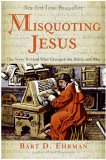
Misquoting I was a little disappointed when I actually came to read Misquoting Jesus but that probably says more about my expectations than about the book itself. Last year I read the quite marvellous Who Wrote the Bible and I was expecting Erhman to do the same thing for the New Testament that Friedman did for the Old.

All the facts were there, and he did a bang up job of telling the story but, overall, I felt like he was trying too hard.

Where Friedman just told a fascinating story about a fascinating episode of our history, Erhman felt like he had an agenda - to persuade the people who believe that the bible is the literal Word of God that it was written by fallible humans with agendas of their own. Since I already believe it was written by fallible humans, the advocacy got in the way of my enjoyment and, since I already knew the broad thrust of the story, it didn’t go deep enough to quench my thirst for knowledge.

It was a good read for all that though. I firmly believe that if kids were taught the history of the bible in school, it would inoculate them from some of the weirder fantasies conjured up by the literalists and they could enjoy the text for the beautiful literature that it is (in parts).

Recommended!

Book Review - The World Without Us

Posted on November 16th, 2007

For a long time, I have had a handful of questions that I kept handy in case I ran into a famous scientist but, one by one, I keep finding the answers to my questions. Questions like: “If the primates got wiped out, from which class would the next Intelligent Species to Dominate The World come?” (answer: Rodents. Thanks to Richard Dawkins in the Ancestors Tale - best book of the century so far).

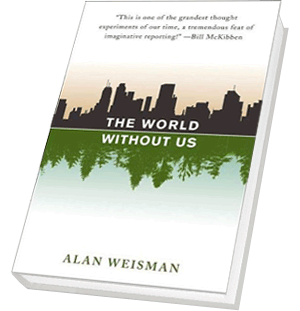
My last remaining question was “How long would it take for all traces of humanity to disappear when we are gone?” so imagine my delight when I heard that someone had written a whole book on that very subject - The World Without Us by Alan Weisman.

World Without UsThe answer is quite encouraging. Much better than I had dared hope.

Starting with the example of what happens to a barn when you cut an 18 inch hole in the roof and then working up through a house with a loose shingle (once the water gets in, it’s all over) he talks us through the destruction of New York City (reverts to forest in a 100 years and then the next ice age removes all trace (but see below about bronze statues)).

Some of our artifacts - like Houston and all its refineries - will cause 100s of years of pain before fading into nothingness but, on the whole, he expects the world to recover quite well. All the rivers will revert to their original courses and all the forests will grow back. In many cases, the original species will also recover and much of our meddling (wheat, cows, maize, dogs) will get eaten or out-competed very quickly.

Cats (and a few ornamental shrubs) are a sad exception to this rule. Apparently they are responsible for an avian holocaust (second only to plate glass in their ability to take down whole species). I always suspected that cats were evil and now I have confirmation.

Some of the best chapters in the book are about some accidental experiments where humanity has temporarily left an area because of war (Cyprus, Korea’s DMZ) or disaster (Chernobyl) and in each case the native species returned very very quickly or lived on when the same species became almost extinct in other areas.

I also enjoyed the mystery of why all the North American mega fauna died out around the same time that men with spears were crossing the Bering Strait (coincidence or…?). Don’t worry though. They will grow back. Not exactly the same of course. Maybe there will be Sabre Toothed Sloths and Giant Ground Tigers instead of what we had before. Meanwhile, we can join the campaign to Bring Back the Elephants!

More depressing are the sections that enumerate our waste products that will stick around for a long time like plastics, tyres, U-235 and dioxins but, one day, some clever bacteria will figure out what to do with them (except the U-235. nature will just have to learn to tolerate that). It’s actually quite shocking what we are doing with plastics and nuclear waste. Before I read the book, it was shocking in an abstract, distant way but now the problem appears quite real and close at hand.

Some of our artifacts that will be around longest include Mount Rushmore, bronze sculpture and the Voyager probes (which will probably outlast the earth) but they are all fairly innocuous so I don’t resent them too much.

All in all, I found the book very uplifting and it almost wants me to hasten our demise so that nature can make a start on restoring some of the beauty that we have destroyed. Which is why I just signed up with the Voluntary Human Extinction Movement.

May we live long and die out!