
When the AI takes our jobs
Everyone has something to say about how AI is going to end the world. My turn.
I don’t expect AI to become more intelligent than us and then kill everyone, but other outcomes are almost as depressing. First of all, there are plenty of jobs where AI will soon be better than people, and AI will steal all the jobs.
Take journalism, for instance. AI is nearly as good as journalists already. There are still great journalists out there, but the nearly-as-good ones will soon be out of a job. Even if the AI is not quite as good, humans will be more expensive, so why not just use the cheaper AI? Maybe the great journalists will stick around for a while, but how will new journalists get started when all the newspapers are gone?
The same future can be expected for programmers, architects, software testers, creative designers, lawyers and the people who make commercials. Any knowledge-based job, really. As with journalists, maybe there will still be work for the best lawyers and the best architects, but we won’t need nearly as many architects and lawyers as we have now. And if we don’t need all those people with brain power, we won’t need the teachers either.
That’s a lot of people without a job.
A lot of people are more optimistic than me. We have been through all this before, they say.
The Industrial Revolution stole the jobs of textile makers, farmers, knocker-uppers and the people who made barrels, but the workers did OK out of the changes. The jobs in the countryside were gone, but they could work in a coal mine or in a factory in the city.
The biggest difference between then and now is that the Industrial Revolution took almost 100 years to wipe out all those jobs. When the AI Revolution comes, the jobs will be gone in just a few years. And what are the jobs that will replace them? We haven’t figured that out yet.
Oh, and by the way, in the Industrial Revolution, lives got worse before they got better. One minute you are weaving sweaters, the next minute you are working in a sweater factory feeding wool into a machine for a fraction of the money. It took a long time for workers’ lives to improve. How will our lives compare?
Maybe, the optimists say, when society becomes more efficient, it will give us everything we need, and we won’t need to work anymore. But have you seen Elon Musk and Jeff Bezos? Do you think they’ll be sharing their trillions? Or will they be piling up their trillions in the Musk and Bezos banks and leaving us to beg for cash to pay for food?
Stephen Hawking had something to say about this.
Everyone can enjoy a life of luxurious leisure if the machine-produced wealth is shared, or most people can end up miserably poor if the machine-owners successfully lobby against wealth redistribution.
So far, the trend seems to be toward the second option, with technology driving ever-increasing inequality.
We might also wonder where AI gets its data from. To take one example, when you search for something on Google…

… Gemini jumps in with the answer.
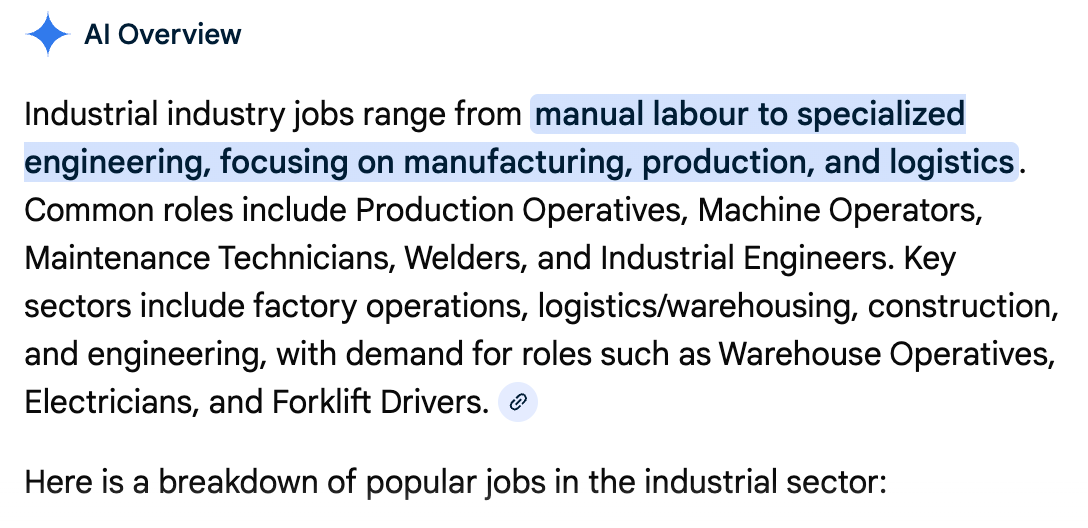
You’ve probably noticed that Gemini steals nearly all its info from the top search result. No one scrolls down and reads a proper website anymore; they just read what Gemini has to say. Who is going to build a website if no one is going to read it? And who is Gemini going to learn from? Maybe they’ll learn from Claude and OpenAI. But where will they learn from?
Many commentators say we should be afraid of the existential risk that comes with superintelligence, but I am more worried by the immediate risk that AI takes away all our jobs.

Maybe we should all learn to be plumbers… until the robots come along.